A Complete Technical Guide for Contractors, Consultants & Fit-Out Specialists in the UAE
In the UAE’s fast-growing construction and fit-out sector, one of the most common challenges contractors face is weak or damaged substrates. Whether it’s an old concrete slab in a Dubai warehouse, moisture-damaged flooring in Abu Dhabi, or uneven screed in Sharjah retail units, weak substrates can lead to:
- Cracking
- Delamination
- Uneven finishes
- Moisture blistering
- Early floor failure
This becomes a serious issue for resin flooring installations, where the base must be strong, stable, and properly prepared.
Epoxy underlays—also known as epoxy underlayment systems, epoxy screeds, or epoxy mortar underlays—offer a powerful solution. When used correctly, they reinforce weak slabs, restore structural integrity, and create the ideal foundation for high-performance flooring systems such as epoxy, polyurethane, polyaspartic, or terrazzo.
This guide explains exactly how epoxy underlays prevent cracking, how they should be installed over weak substrates, and why they have become essential in the UAE’s demanding commercial and industrial environments.
Understanding What Epoxy Underlays Are
Epoxy underlays are high-build, reinforced resin systems designed to strengthen and level weak or deteriorated substrates. They are typically a mixture of:
- 100% solids epoxy resin
- Graded silica sand or quartz
- Optional fibers or fillers
- Specialty adhesion promoters
These underlays cure into extremely tough, impact-resistant layers that bond tightly to existing surfaces.
Different forms include:
- Epoxy mortar underlays (thick, strong, ideal for heavy-duty floors)
- Epoxy screeds (for leveling large uneven surfaces)
- Epoxy slurry coats (medium-strength resurfacing)
- Epoxy moisture barrier underlays (for damp or moisture-vulnerable slabs)
They are the go-to solution when surface conditions are not ideal for direct epoxy topcoating.
Why Weak Substrates Fail in the UAE
UAE climatic conditions and construction practices often produce challenging substrate issues:
1. High Moisture Vapor Emission (MVE)
Concrete in Dubai, Abu Dhabi, Ras Al Khaimah, and Sharjah frequently retains high moisture due to:
- High humidity
- Groundwater proximity
- Rapid construction timelines
Moisture causes bubbling, blistering, and delamination in resin floors.
2. Rapid Construction Schedules
Fast-paced fit-out timelines in:
- Malls
- Retail stores
- Warehouses
- Residential towers
often lead to improperly cured concrete or weak screed layers.
3. Heat-Induced Expansion and Contraction
Extreme UAE temperatures create thermal stress, especially in basement floors, rooftops, loading bays, and exposed slabs.
4. Old or Damaged Slabs
Older buildings undergoing renovation often have:
- Dusty surfaces
- Cracks
- Weak laitance
- Surface unevenness
Epoxy underlays are the best solution to address these issues before installing premium flooring systems.
How Epoxy Underlays Prevent Cracking on Weak Substrates
Epoxy underlays enhance slab strength in multiple ways:
1. High Compressive Strength
Epoxy mortar underlays achieve compressive strengths of 50–90 MPa, far exceeding typical concrete strengths in the UAE (25–40 MPa).
This prevents surface cracking under foot traffic, equipment loads, and thermal stress.
2. Superior Bond Strength
Epoxy chemically bonds to concrete, creating a monolithic surface.
This eliminates issues like:
- Delamination
- Peeling
- Hollow spots
3. Load Distribution
Epoxy underlays act as a shock-absorbing layer, distributing impact loads evenly across weak areas.
4. Fills Voids, Honeycombs & Surface Defects
Weak spots are filled and densified, preventing stress concentration that leads to cracking.
5. Moisture Resistance
Moisture-tolerant epoxy underlays stop vapor transmission, preventing blistering and osmotic pressure.
6. Reinforced With Aggregates
Silica/quartz aggregates create a dense, stone-like composite layer.
7. Flexible Additives to Withstand Movement
Some systems include elastomeric properties to resist substrate-induced cracks.
Where Epoxy Underlays Are Most Needed in the UAE
✔ Old Warehouses in JAFZA, Al Quoz, ICAD, DIP
To repair dusting floors or weak concrete before new epoxy coatings.
✔ Retail Fit-Outs in Dubai Mall, Mall of the Emirates, Yas Mall
To correct uneven screed and achieve flawless luxury finishes.
✔ Industrial Facilities in Sharjah & Ras Al Khaimah
To strengthen slabs exposed to forklift traffic and heavy machinery.
✔ Residential Buildings & Villas
To repair moisture-damaged or hollow screeds before installing decorative epoxy or microcement.
✔ Basements & Parking Areas
To prevent moisture seepage and cracking.
✔ Food, Healthcare & Pharma Facilities
To ensure hygienic, seamless floors without substrate defects.
Proper Installation Method: How to Install Epoxy Underlays Over Weak Substrates
A successful installation requires following industry best practices. Below is a professional UAE-standard workflow.
1. Substrate Assessment
Include:
- Hardness testing (Schmidt hammer or Mohs scale)
- Moisture testing (CM test or Tramex meters)
- Crack identification
- Checking for hollow spots
Weak areas are marked for repair.
2. Mechanical Surface Preparation
This is crucial for strong bonding.
Methods include:
- Shot blasting
- Diamond grinding
- Scarifying
- Vacuuming
Weak laitance is removed until a CSP-3 to CSP-5 concrete profile is achieved (per ICRI standards).
3. Crack Repair & Structural Patching
Structural cracks are routed and filled with:
- Epoxy crack injection resin
- Epoxy repair mortar
- Fiber-filled filler compounds
This prevents substrate movement from reflecting through the epoxy.
4. Priming with Moisture-Tolerant Epoxy
A moisture-resistant epoxy primer is applied to:
- Seal the substrate
- Increase adhesion
- Prevent air and moisture from rising
Duraamen’s moisture-tolerant primers are ideal for UAE conditions.
5. Application of Epoxy Underlay
Depending on the requirement:
A. Epoxy Slurry (1–2 mm)
For light leveling.
B. Epoxy Screed (3–6 mm)
For moderate leveling and improving strength.
C. Epoxy Mortar Underlay (6–12 mm+)
For heavily damaged substrates or industrial floors.
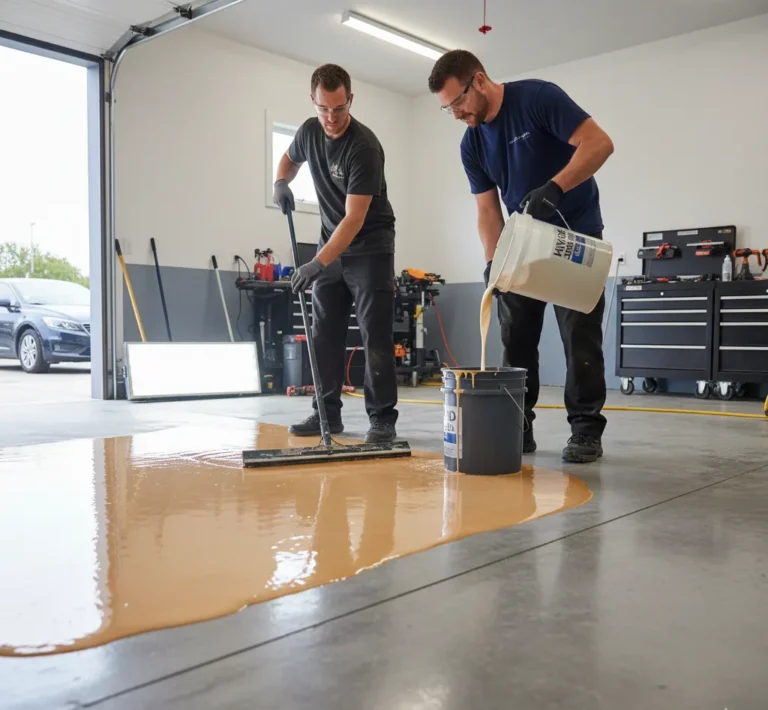
The material is thoroughly mixed, trowel-applied, and smoothed.
6. Sand Broadcasting for Mechanical Grip
While the underlay is still wet, silica sand is broadcast to rejection.
This ensures strong bonding with the final flooring system.
7. Final Flooring System Installation
Once cured, installers apply:
- Self-leveling epoxy
- Polyaspartic coatings
- Urethane systems
- Decorative flake/metallic floors
- Microcement overlays
The underlay creates a stable, crack-resistant foundation.
Benefits of Using Epoxy Underlays in the UAE
✔ Avoids Cracking & Delamination
Strengthens the surface so that cosmetic floors don’t fail.
✔ Allows Installation Over Weak Substrates
Avoids costly demolition of old concrete.
✔ Improves Floor Lifespan
Increases durability and structural integrity.
✔ Provides a Perfectly Level Surface
Critical for decorative floors in showrooms and retail interiors.
✔ Reduces Downtime
Epoxy underlays cure quickly—ideal for UAE’s fast-paced fit-out schedules.
✔ Cost-Effective Rehabilitation Method
Much cheaper than replacing slabs or screeds.
✔ Moisture Protection
Essential in basements, cold rooms, and ground floors.
Epoxy Underlays vs Traditional Cementitious Underlays (UAE Comparison)
| Feature | Epoxy Underlays | Cementitious Screeds |
| Bond Strength | Very High | Moderate |
| Moisture Resistance | Excellent | Poor |
| Crack Resistance | High | Low |
| Cure Time | Fast | Slow |
| Durability | Very High | Moderate |
| Thickness | 1–12+ mm | 10–70 mm |
| Load Tolerance | Heavy Duty | Medium |
| Best For | Weak substrates, industrial floors, decorative resin floors | Basic leveling work |
Epoxy underlays clearly outperform cementitious screeds in UAE commercial and industrial settings.
Why Duraamen Epoxy Underlays Are the Best Choice in the UAE
✔ Engineered for High Moisture Environments
Our moisture-tolerant primers and underlays prevent osmotic blistering.
✔ Extremely High Compressive Strength
Ideal for heavy-duty applications like warehouses and showrooms.
✔ Seamless Compatibility with All Duraamen Flooring Systems
Including metallic epoxy, 100% solids epoxy, polyaspartic, and urethane floors.
✔ Fast Installation
Perfect for mall fit-outs with tight handover deadlines.
✔ Proven in UAE Projects
Used across Dubai, Abu Dhabi, Sharjah, and RAK in retail, industrial, and commercial applications.
Final Thoughts
Epoxy underlays are one of the most powerful tools for upgrading weak substrates in UAE construction and fit-out environments. Whether you’re preparing a retail boutique in Dubai Mall, a logistics warehouse in JAFZA, or a villa in Abu Dhabi, a properly installed epoxy underlay ensures:
- No cracking
- No delamination
- No moisture blistering
- A flawless high-performance floor
Duraamen’s advanced resin technologies are engineered specifically for the region’s climate and construction needs, delivering long-term durability and improved substrate stability.
FAQs
1. Can epoxy underlays be installed over very weak or powdery concrete?
Yes, as long as the weak surface layer is removed during surface preparation. Epoxy underlays bond strongly to sound concrete.
2. Do epoxy underlays crack?
No. When installed correctly, epoxy underlays resist cracking even on weak slabs because of their high compressive strength and flexibility.
3. What thickness of epoxy underlay is required for UAE industrial floors?
For heavy-duty areas, 6–12 mm epoxy mortar underlays are recommended.
4. Are epoxy underlays suitable for retail and decorative floors?
Absolutely. They are essential for achieving a perfectly smooth surface before applying metallic epoxy, polyaspartic, or microcement finishes.
5. Does UAE humidity affect epoxy underlays?
No. Moisture-tolerant epoxy primers and underlays are specifically designed to handle UAE humidity and vapor transmission.
6. Can epoxy underlays fix an uneven floor in a Dubai Mall retail unit?
Yes. Epoxy screeds and underlays are commonly used for leveling floors during fit-out works in malls.
7. Can epoxy underlays be used in villas or residential spaces?
Yes. They are ideal for repairing damaged screeds or achieving smooth substrates for decorative flooring.
8. How long does an epoxy underlay take to cure?
Most systems cure within 6–12 hours depending on temperature.
9. Are epoxy underlays expensive?
They are cost-effective compared to removing and replacing concrete, and they significantly extend the life of the final flooring system.
10. Can Duraamen underlays prevent moisture-related failures?
Yes, when combined with a moisture-tolerant primer, they block vapor movement and eliminate blistering.